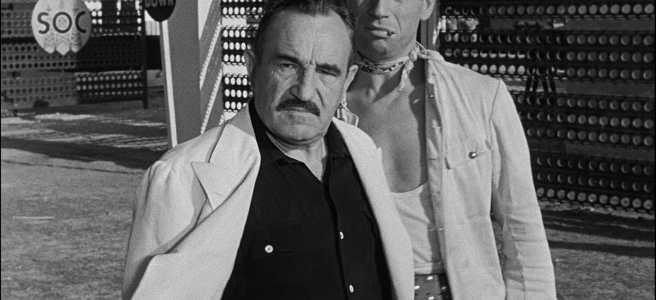
I cannot comment on the connection that The Wages of Fear has to Le Salaire de la peur, the source novel that I have not read. But I readily draw connections between The Wages of Fear and the novels of B. Traven, of which I am very fond. Clouzot's film and Traven's novels are both … Continue reading #36. The Wages of Fear. Dir., Henri-Georges Clouzot
Tag: numbers 1-100
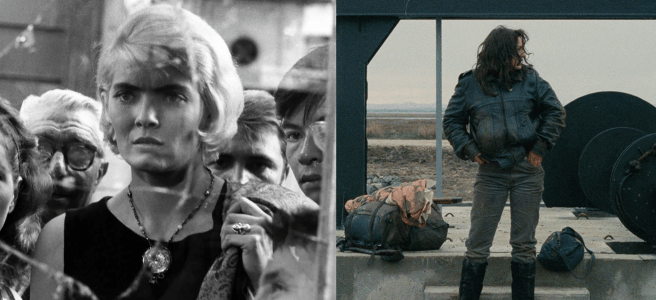
#73. Cléo from 5 to 7, and #74. Vagabond. Dir., Agnes Varda
The movie offers two forms of magic, since its conquest of the visible world extends in two opposite directions. The first, on which the realist theory concentrates, gives it the power to 'possess' the real world by capturing its appearance. The second, focus of the traditional aesthetic, permits the presentation of an ideal image, ordered … Continue reading #73. Cléo from 5 to 7, and #74. Vagabond. Dir., Agnes Varda
SCMS Presentation: The Political Economic Roots of Hollywood Strikes, 1950-2023
Abstract This paper investigates the timing of labour strikes in Hollywood. The occurrence of strikes, such as the WGA and SAG-AFTRA strikes in 2023, can make sense when we have the hindsight to piece together the historical details of what created rifts between labour and management. But was 2023 a particularly fragile year for contract … Continue reading SCMS Presentation: The Political Economic Roots of Hollywood Strikes, 1950-2023
#97. Do The Right Thing. Dir., Spike Lee
In the middle of Spike Lee's Do The Right Thing there is a quick cultural reference that is easy to miss, or at least misinterpret as simply a joke. Da Mayor, an elderly drunk in the neighborhood, stops a boy on the street and asks, "What makes Sammy run?" The boy replies, "My name is … Continue reading #97. Do The Right Thing. Dir., Spike Lee
#93. Black Narcissus. Dirs., Michael Powell and Emeric Pressburger
The shooting of Black Narcissus at Pinewood Studios, London, England is partly what makes the film so beautiful. For the audience to believe that St. Faith, the new school and hospital for a small Indian village, is situated high up in the Himalayas, giant matte paintings created an illusion that green valleys were thousands of … Continue reading #93. Black Narcissus. Dirs., Michael Powell and Emeric Pressburger
#90. Kwaidan. Dir., Masaki Kobayashi
Kwaidan is comprised of four Japanese ghost stories, each inspired by one of the stories in Lafcadio Hearn's 1904 anthology, Kwaidan: Stories and Studies of Strange Things. At the time of filming, Kobayashi's Kwaidan was the most expensive Japanese film ever produced. Its high cost of production is up on the screen. As the film … Continue reading #90. Kwaidan. Dir., Masaki Kobayashi
#61. Monty Python’s Life of Brian. Dir., Terry Jones
An expanding DVD market and digital streaming made the Criterion Collection edition of Life of Brian superfluous. I purchased the CC copy of Life of Brian before a cheaper copy was available; and, even if there was one somewhere out there, I could not imagine how, as I held a sixty dollar DVD in my … Continue reading #61. Monty Python’s Life of Brian. Dir., Terry Jones
#53. Sanjuro. Dir., Akira Kurosawa
A DVD copy of Sanjuro was gifted to me. If I had purchased a hard copy myself, I definitely would never have skipped buying Yojimbo, the first in the pair of films about Sanjuro, the ronin who names himself “30 years old”. Sanjuro is a film for the those--investors and samurai fans alike--who wanted more … Continue reading #53. Sanjuro. Dir., Akira Kurosawa
#45. Taste of Cherry. Dir., Abbas Kiarostami
"Change your outlook ..." . This prescription is given to Badii by the Azeri taxidermist. Of the three passengers Badii picks up to solicit help in his plan for suicide, the taxidermist is the most vocal in his disagreement of Badii's intentions. In sharp contrast to the young soldier, whose nervousness from Badii's appeals made … Continue reading #45. Taste of Cherry. Dir., Abbas Kiarostami
#34. Andrei Rublev. Dir., Andrei Tarkovsky
Andrei Rublev is a beautiful study of an artist's relationship with his/her social circumstances. With patient camera movement and long takes, Tarkovsky presents Rublev, the 15th-century Russian icon painter, as someone who is internally split between a desire to paint in ignorance of social turmoil and a curiosity to get as close as he can … Continue reading #34. Andrei Rublev. Dir., Andrei Tarkovsky