
In the moment, many films with explicit politics can feel powerful. Impassioned character dialogue, visual imagery of resistance, or thematically-structured arguments will often strike the audience with the force of a heavyweight boxer. But afterward, the same audience stands and notices, more often than not, that none of the punches left even a mark. Nothing’s changed and there is no evidence that an explosive political rumble just happened.
The Battle of Algiers is that rare political film whose effect on the audience does not quickly fade after a viewing. For this review, we can define a political film as having an explicit argument about the need to reorganize society according to a conception of freedom or justice. The Battle of Algiers is arguing that French colonialism in Algeria is unjust and that Algerian freedom depends on France’s exit from the country. The lasting effect of The Battle of Algiers comes from its commitment to present the French-Algerian relationship with enough complexity that even the person ready to cheer for the Algerian resistance fighters will, going through a viewing of The Battle of Algiers, need to consciously re-affirm their political position with nuance and rebuttal.
The Battle of Algiers does such a good job removing flimsy characterizations from its story that the film had an infamous second life as a training video for American counter-terrorism during the Second Iraq War. It is easy to shudder at the thought of American agents of Homeland Security, the CIA, or other counter-terrorism trainees watching the torture scenes of The Battle of Algiers and making note for how they will gather information from Iraqi civilians. Yet the counter-revolutionary perspective in The Battle of Algiers is neither superficial nor buried deep in subtext. Pontecorvo uses the character of Colonel Mathieu in a way that is similar to how John Ford uses the character of Ethan in The Searchers. Col. Mathieu is unapologetic about his goal to crush the FLN. He is shrewd and he intelligently predicts how each side of French society, including his own soldiers, will interpret his brutal tactics. If Ethan famously cannot cross the threshold at the end of The Searchers, Col. Mathieu is conscious of how he is going to become, at the end of the story, the ruthless beast that French society needs to maintain its colonial power in Algeria.
The challenge to the audience’s political position comes not from the showing of civilians, mainly French-Algerian civilians, being killed from bombings and other violent acts. Rather, the film pushes its audience to reflect on its political position because characters on both sides of the battle engage in discussions about the political necessities of committing these levels of violence. Moreover, Algerian and French characters each recognize how this violence is an outcome of the absolute incompatibility between the goals of the FLN (an independent Algeria without France) and the French government (paratroopers will defend France’s colony to the death).
The plot of The Battle of Algiers is mainly built on the stories of notable FLN revolutionaries, such as Ali La Pointe. Pontecorvo uses montage to show the audience the larger scope of Algerian resistance. The expanded view shows how the personal (particular, individual, small) is always swirling in the whirlpool of the political (universal, social, big). Ordinary Algerians in the Casbah appear in montages to demonstrate that there is not enough running time in The Battle of Algiers to give background on the courage and convictions of the many Algerians contributing to the resistance. As a mirroring effect to the help Algerian civilians provide FLN fighters, Col. Mathieu recognizes the same personal-political mixture, but as something to be combated. When reviewing the surveillance footage of checkpoints in the Casbah, Col. Mathieu explains to the French soldiers that the innocence of ordinary Algerian civilians can be deceiving; behind the facade of ordinariness is anti-colonial anger. At any moment one, many, or all of the people in the footage could attack the French army.
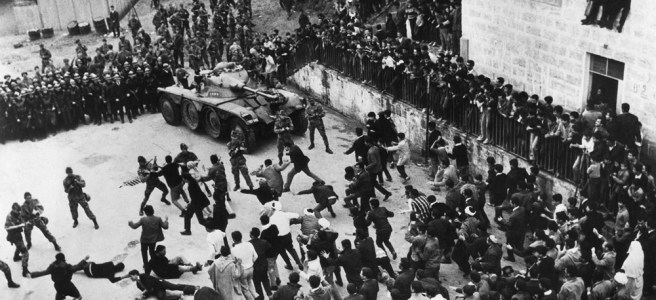
Pontecorvo uses the final scenes of the film to erase the last traces of any division between the personal and the political. The French army has the hiding place of Ali La Pointe and other FLN fighters surrounded. By refusing to surrender, the revolutionaries are killed after Col. Mathieu gives the order to use explosives to detonate the wall of the hiding place. Ordinary Algerians have been listening to this attack from the rooftops of the Casbah. They solemnly mourn the deaths of their fighters in a camera pan that then cuts to the social aftermath of French soldiers sweeping the Casbah through torture and killing. The cut is to another explosion — this time a political one of mass protest. In the coda of The Battle of Algiers, the fears of Col. Mathieu have come alive in the shouts of ordinary men the ululations of ordinary women. Rather than retreat inward from fear, ordinary people of Algeria openly refuse the presence of France in Algeria.

 notes on cinema