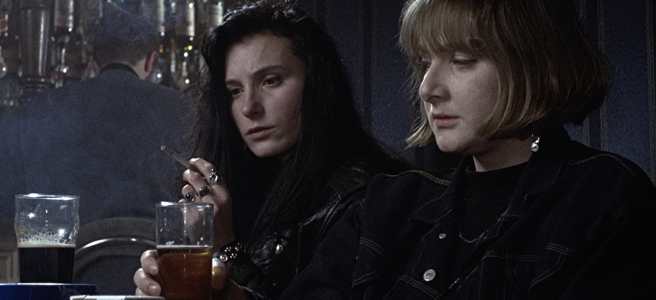
A misanthrope in a Leigh film can't ever seem to turn their hatred off. This is undoubtedly the most memorable quality of David Thewlis' performance in Naked as Johnny. There is no respite from his nastiness. Some mistakenly believe they can find a better side of him, whether that be rational or compassionate. For instance, … Continue reading #307. Naked. Dir., Mike Leigh
Category: wmcocc
#300. The Life Aquatic with Steve Zissou. Dir., Wes Anderson
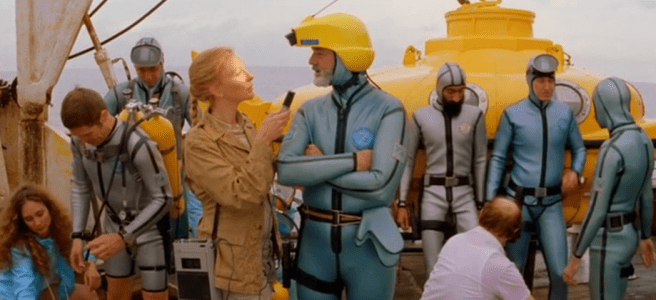
As Wes Anderson's fourth film, The Life Aquatic with Steve Zissou has an interesting spot in Anderson's career. Look backward and you can see within Life Aquatic many of the style choices that Anderson had used before. When looking forward, Life Aquatic is the beginning of Anderson's interest of using miniatures and stop motion animation. … Continue reading #300. The Life Aquatic with Steve Zissou. Dir., Wes Anderson
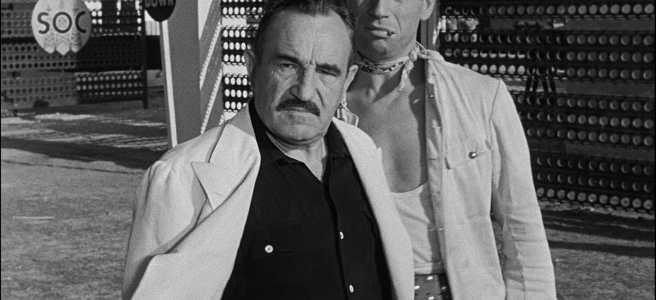
#36. The Wages of Fear. Dir., Henri-Georges Clouzot
I cannot comment on the connection that The Wages of Fear has to Le Salaire de la peur, the source novel that I have not read. But I readily draw connections between The Wages of Fear and the novels of B. Traven, of which I am very fond. Clouzot's film and Traven's novels are both … Continue reading #36. The Wages of Fear. Dir., Henri-Georges Clouzot
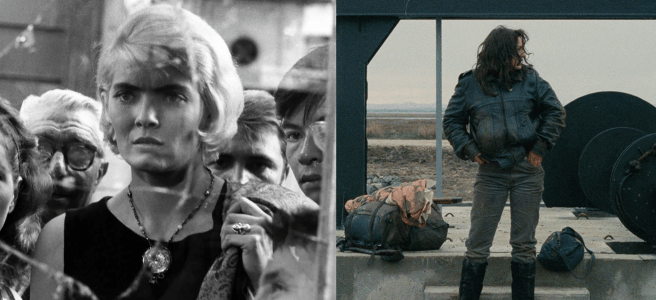
#73. Cléo from 5 to 7, and #74. Vagabond. Dir., Agnes Varda
The movie offers two forms of magic, since its conquest of the visible world extends in two opposite directions. The first, on which the realist theory concentrates, gives it the power to 'possess' the real world by capturing its appearance. The second, focus of the traditional aesthetic, permits the presentation of an ideal image, ordered … Continue reading #73. Cléo from 5 to 7, and #74. Vagabond. Dir., Agnes Varda
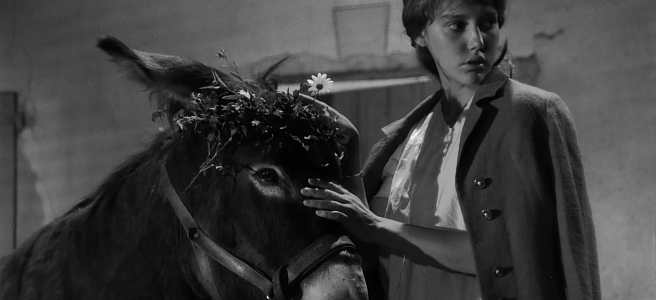
#297. Au Hasard Balthazar. Dir., Robert Bresson
Bresson's style is not everyone's cup of tea, but a film like Au Hasard Balthazar is a quick path to understanding the depth of cinema's potential as an art form. Typically a film, even a really good one, is an industrial composite, a product from a system that is not always about putting the best … Continue reading #297. Au Hasard Balthazar. Dir., Robert Bresson
#97. Do The Right Thing. Dir., Spike Lee
In the middle of Spike Lee's Do The Right Thing there is a quick cultural reference that is easy to miss, or at least misinterpret as simply a joke. Da Mayor, an elderly drunk in the neighborhood, stops a boy on the street and asks, "What makes Sammy run?" The boy replies, "My name is … Continue reading #97. Do The Right Thing. Dir., Spike Lee
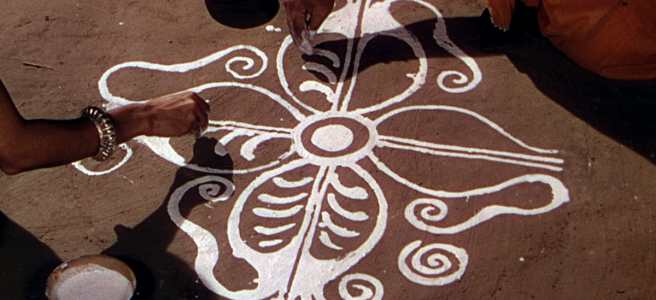
#276. The River. Dir., Jean Renoir
The River has the power to reveal the extent to which other Western films about Southeast Asia will rely on Orientalist tropes about poverty, spirituality, and naturalism. Whether out of a fear of reproducing visual stereotypes or from a keen awareness that he has a lot to learn about India, Jean Renoir decided to adopt … Continue reading #276. The River. Dir., Jean Renoir
#249. The Battle of Algiers. Dir., Gillo Pontecorvo
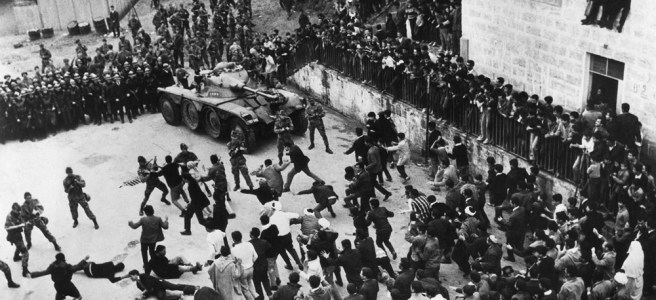
In the moment, many films with explicit politics can feel powerful. Impassioned character dialogue, visual imagery of resistance, or thematically-structured arguments will often strike the audience with the force of a heavyweight boxer. But afterward, the same audience stands and notices, more often than not, that none of the punches left even a mark. Nothing's … Continue reading #249. The Battle of Algiers. Dir., Gillo Pontecorvo
#235. The Leopard. Dir., Luchino Visconti
Let's begin with the ending of Visconti's The Leopard. Having attended a ball that went all night and into the early hours of the next morning, Don Fabrizio Corbera, the Prince of Salina, refuses a carriage ride back to his estate. He decided he would walk home alone. This ending is not the ending of … Continue reading #235. The Leopard. Dir., Luchino Visconti
#198. Ali: Fear Eats the Soul. Dir., Rainer Werner Fassbinder
As a visual medium, cinema has its own pathways for an audience to recognize the tragedy of a society forbidding the love between people. A film's script can make the tragedy explicit through the dialogue of approving or disapproving characters, but the visual nature of a film opens multiple opportunities for the couple to communicate … Continue reading #198. Ali: Fear Eats the Soul. Dir., Rainer Werner Fassbinder