
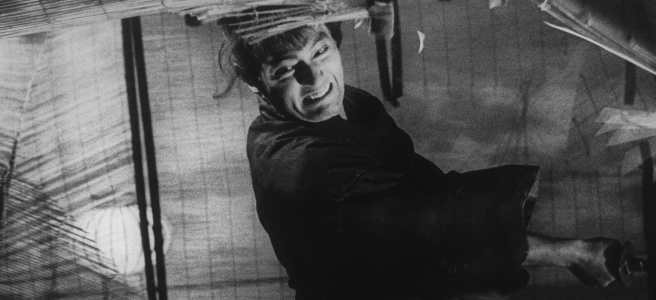
The omission of information in a story is typically a frustrating shortcoming that prevents the audience from understanding the motivations or relationships of characters. The Sword of Doom provides no history of feudal Japan and gives us almost nothing about the past of Ryunosuke Tsukue, a samurai that kills with a combat style that feigns a defensive, almost disinterested stance. Rather than being a deficit in storytelling, the little we know about Tsukue is a method to highlight his main trait: he is a soulless killing machine. Okamoto’s film jumps straight to the frightening conclusion of a life that was built on the deaths of others. As Geoffrey O’Brien’s puts it in his essay for the Criterion Collection edition of the film, “The film’s surface, one might say, is its depth: if indeed an evil soul is an evil sword, then form and gesture are a graph of profound undercurrents.”
But the surface of The Sword of Doom is not as simple as it sometimes looks. Cinema, from Japan and elsewhere, is filled with characters who have been transformed from the killing of others. One theme of this transformation, particularly in war stories, is that away from a battlefield, or absent the oncoming thrust of a blade, someone lacks the hatred or reason to harm another. Tsukue seemingly breaks this mold in the first five minutes of The Sword of Doom by killing an elderly man who is traveling a mountain pass with his granddaughter. But this man was praying for death at a Buddhist shrine — so is Tsukue fulfilling the wish of this man out of duty? In many scenes he is attacked first, but Tsukue always appears resigned to walk the paths that will conclude with combat. Do the actions that lead to an attack negate his position of self-defense? The facial expressions of Tatsuya Nakadai, the actor who plays Tsukue, also create mystery about the extent to which killing has transformed Tsukue. Perhaps he once lived a life that did not give him reason to carry empty, expressionless stares. Yet Nakadai will also give Tsukue’s character a devilish smirk in the middle of a fight, which suggests something terrifying: somehow Tsukue was born to be this violent.


