
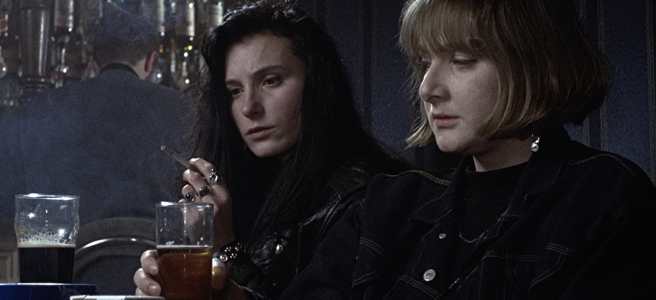
A misanthrope in a Leigh film can’t ever seem to turn their hatred off. This is undoubtedly the most memorable quality of David Thewlis’ performance in Naked as Johnny. There is no respite from his nastiness. Some mistakenly believe they can find a better side of him, whether that be rational or compassionate. For instance, as Johnny wanders the streets of London and rests at the door of an office building, he meets its security guard. Both are autodidacts, and this initially makes the security guard keen to carry on a conversation with Johnny. But it only takes a few rooms in his routine patrol before his pseudo-philosophy of time is torn apart by Johnny. And that isn’t all. In between his speeches, Johnny sprinkles in commentary that the guard is a boring nobody, his security job is useless, and his plan to retire to a cottage in Ireland stupid. Johnny also goes across the street to degrade and assault a woman that the security guard admires secretly from one of the office’s latticed windows.
Of the films of Leigh’s that I have seen, I believe Naked is Leigh’s best examination of the ways a person’s hatred of others is transformed by their class. A misanthropic character in a Mike Leigh film will often be working class or lack the social status to turn their ideas of truth and morality into something concrete. Johnny is an extreme version of this type. He is seemingly unemployed and self-exiled from his home in Manchester, but he holds a sense of intellectual superiority above everyone that will cross his path. Yet Johnny also fails to recognize that his social circumstances will only give him audiences with other powerless people, who have suffered from loneliness, boredom, and alienation before they ever met him. When he spews ideas, he might be imagining that he has the ears of the powerful, whom, once rebuked, would surrender to his philosophical genius.
The class character of Johnny’s anger is highlighted in contrast to the misogyny of Jeremy G. Smart/Sebastian Hawk. Jeremy/Sebastian is perhaps what Johnny would be if he were a rich professional. High social status has given Jeremy/Sebastian the power to laugh away the brutality of his sexual violence on women, especially on those who were initially charmed by his material wealth. Jeremy/Sebastian can also hide his evil character behind luxury cars, slick hair, expensive clothes, and perfect posture. By contrast, Johnny has no social armor to protect his body and mind from the effects of his behavior. Having fled Manchester after committing rape in an alley, he carries with him on the streets of London only one bag of possessions. Each interaction to the end of the film renders him more unkempt and with greater pain.
Leigh’s dry style casts no judgement on Johnny nor Jeremy/Sebastian. However, Leigh’s style also demonstrates how themes of power cannot be explored if the film communicates its moral judgement of misanthropy broadly or with too much emotion. For instance, Johnny’s night in the streets of London ends with him being beaten in an alley by a gang of strangers. Returning to Louise and Sophie’s flat, Johnny falls unconscious in the hallway. Jeremy/Sebastian, who has raped Sophie and has been sleeping in her room, enters the hallway to see a prone Johnny. Another director might feel compelled to use this moment to explicitly ground Jeremy/Sebastian in condemnation, perhaps by having Jeremy/Sebastian see a piece of himself in the bloodied and bruised face of Johnny. Instead, Leigh uses the scene as to have Jeremy/Sebastian express cold contempt for Johnny’s fate: “Pathetic.” One misanthrope does not automatically find kinship or likeness in another, especially if an enormous gap in social status is between them. To Jeremy/Sebastian, Johnny does not have the the power to give his violence social security.


