
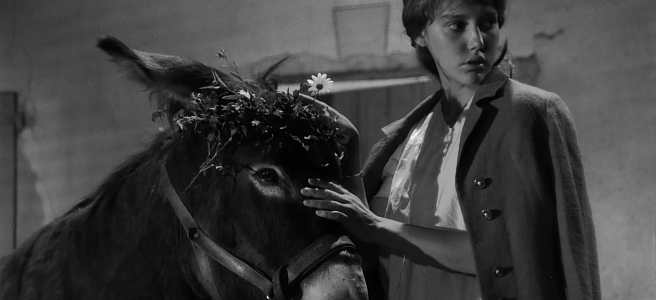
Bresson’s style is not everyone’s cup of tea, but a film like Au Hasard Balthazar is a quick path to understanding the depth of cinema’s potential as an art form. Typically a film, even a really good one, is an industrial composite, a product from a system that is not always about putting the best possible picture on screen. It is difficult to imagine that the production of a Bresson film was ever contaminated with the profit incentives of nosy producers, managers and executives — all delivering notes to do this or do that. In fact, if a Hollywood executive were transported back in time to the shooting of a Bresson film, they might stay frozen in place from the shock of witnessing Bresson apply his philosophy on cinema. It is just as dangerous to mainstream commercialism as directors who dream of having huge budgets for their grand visions.
Much has been written about Bresson and his ascetic style. What I find so incredible about the “Bressonian” style is that its aesthetic power is mostly contained to the duration of the film. Memories of watching a Bresson film are only filled with faded images and partial remembrances of plot. Such could be the cost of being an active spectator. The tremendous flow of meaning and imagery stays with the transmitted light because a Bresson film is calling for meaning to be given, not the other way around.
But Bresson’s audience does not have the freedom to give any meaning to images on screen. Instead, a film like Au Hasard Balthazar forces the spectator to abandon ready-made concepts, as the images of everyday objects are somehow unfamiliar. Shots of hands, wheels, doors, and other objects of the world easily read as plot progression in other films — a film crew would likely label them as the “insert shots” needed to make action coherent — but not in a Bresson film. The simplicity of an everyday object suddenly is mysterious, and you find yourself needing ninety to a hundred minutes to ask naive questions like “What is a hand?” or “What is a money bill”? Balthazar the donkey is a strong example of this type of questioning. Is Balthazar and other donkeys placed on this earth to obey human masters? Are some animals more noble than others? Is the innocence of Balthazar innate or a projection of morality onto nature? Thinking about the social-natural dichotomy or the meaning of hierarchy in the animal kingdom, even for the duration of a film, initially feels alien, but its because people, objects, and mundane behaviors have assumed places in a totality of social hierarchy and function. Day to day, the logic of this totality is invisible because it is second nature. But Bresson understands that philosophy can be borne from questions society labels to be childish or pointless.

 notes on cinema