
The movie offers two forms of magic, since its conquest of the visible world extends in two opposite directions. The first, on which the realist theory concentrates, gives it the power to ‘possess’ the real world by capturing its appearance. The second, focus of the traditional aesthetic, permits the presentation of an ideal image, ordered by the film-maker’s will and imagination. Since the cinema’s mechanism incorporates both these tendencies, neither of them can be condensed on rational, technical or aesthetic grounds. A useful film theory must acknowledge the range and diversity of the film-maker’s achievements. At one end of the scale we find the most rigorous forms of documentary, which aim to present the truth about an event with the minimum of human intervention between real object and its film image; at the other end lies the abstract, cartoon or fantasy film which presents a totally controlled vision.
— V.F. Perkins, Film as Film, p.60
The writings of Perkins can be hard to disagree with because he is telling us that he is creating a useful approach to appreciating the art of cinema. According to Perkins, philosophical searches for the essence of cinema are misguided because narrative films are aesthetic and technological mutts, the mixed children of theatre, painting, photography, music, and literature. There is no pure foundation of film aesthetics and filmmakers are doing what they need to do to tell a good story. For instance, when montage is a useful technique to show action, a filmmaker uses it: “editing is a stylistic means rather than an aesthetic end” (p. 114).
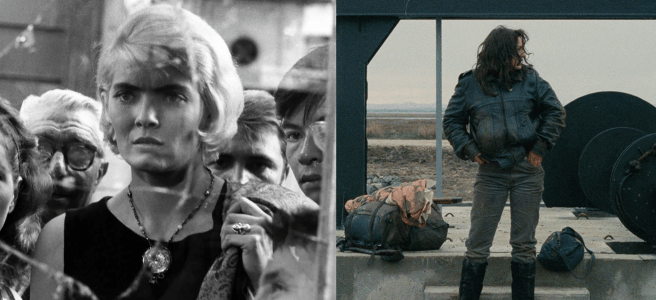
Two films by Agnes Varda — Cléo from 5 to 7 and Vagabond — show how pragmatic definitions of cinema aesthetics, like the one provided by Perkins, sneak an ideal aesthetic type in through the back door. Perkins might have rolled his eyes at theorists like Bazin, who mulled over the objectivity of the photographic image, but Perkins still has to hold an ideal in his head if he is going to differentiate the good from the bad. The aesthetic ideal Perkins uses to pass judgement is the idea of coherence. As long as a film is using every image to help build a coherent world, Perkins is free to care less about the differences of aesthetic styles and technologies. This ideal of coherence is glimpsed in Perkins’ reflections on the idolization of Battleship Potemkin. As Perkins argues against inflating montage to being more than just one technique among many, he reflects on the significance of the sequence of images in Battleship Potemkin that make it look like stone statues of lions have awoken:
… it seems a serious criticism of Eisenstein’s device that the lions served no purpose in the movie beyond that of becoming components of a montage effect. They were not represented as, for example, elements of the Odessa setting, nor as targets for the Potemkin’s attack. The absence of connection, in terms of story, action, location — the absence of any dramatic connection at all — entailed an extreme imprecision of effect. The director’s own interpretation was this: “In the thunder of the Potemkin’s guns, a marble lion leaps up, in the protest against the bloodshed on the Odessa steps.’ But that hardly seems the case.
— V.F. Perkins, Film as Film, p.103-104
Perkins is trying to take a position that looks like he doesn’t need to draw from a larger philosophy of aesthetics; but here he is judging the ultimate significance of a technique. The films of Varda are fascinating counter-examples to Perkins’ attempts at pragmatism. Her films demonstrate that coherence, explicitly or implicitly, need not be the standpoint to judge technique. Varda’s two films both contain a mixture of styles; in Vagabond, this mixture — documentary and narrative — is more separated than it is in Cléo from 5 to 7. None of the styles in these films by Varda are working together for one coherent purpose. In her state of uncertainty about her health, Cléo is multiple things at once: alive, dying, alone, loved, joyful, fortunate, unlucky. The is no one true Cléo, and Varda is not mixing styles — neo-realism, musical theatre, documentary — and techniques — handheld, fixed point-of-views, dolly tracking shots — to get any closer to a central point. One might say that the “coherent” theme of Cléo from 5 to 7 is the absence of knowing Cléo truly. But this argument is on a slippery slope that leads back to a deeper theory of how incoherence becomes coherence.
Should Perkins’ pragmatic theory of cinema claim Cléo from 5 to 7 as an example that supports it, there will be more difficulty keeping its ideal standard of coherence secret in a judgement of how film techniques vary in Vagabond. Acknowledging that good films have been produced through the use of different styles and techniques is not hard because it is safe. Appreciating the mixture of styles in Vagabond is more difficult and requires a theory of why the line separating narrative and documentary styles will sometimes blur and sometimes not. For example, are the documentary-scenes embedded in the fictional story of Mona, such that there is an actual film crew piecing a story together for a documentary or news story? If so, some of the recorded testimonies are out of place; they don’t seem to be speaking to an interviewer, or even a camera, and some end with pans better suited for third-person viewpoints. If, on the other hand, the documentary-like testimonies of characters are constructions of Varda, do they access truths about Mona that cannot be gotten to by narrative filmmaking? Much like she did with Cleo, Varda might not even be searching for a better understanding of Mona.

 notes on cinema