
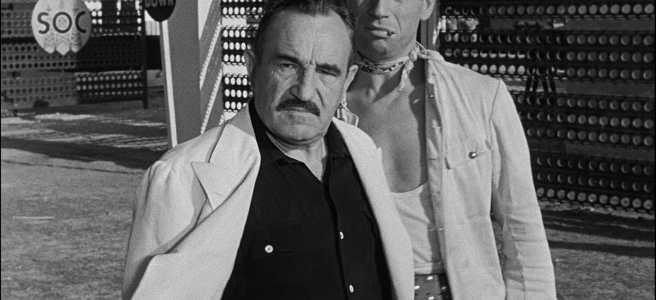
I cannot comment on the connection that The Wages of Fear has to Le Salaire de la peur, the source novel that I have not read. But I readily draw connections between The Wages of Fear and the novels of B. Traven, of which I am very fond. Clouzot’s film and Traven’s novels are both masterful allegories of how the political ideals of radical democracy are easily corrupted when a seemingly suitable local environment for democracy is contaminated by a larger system of power. Their protagonists recognize the clear benefits to solving problems through the rejection of hierarchy. The nitro glycerine that the four drivers must deliver in The Wages of Fear does not have to be a suicide mission — if only all four drivers address each obstacle by listening to reason. Travern’s The Treasure of the Sierra Madre is a thematic antecedent, as the benefits of coordination in finding gold are obvious to each of the three main characters.
The tragedy of The Wages of Fear also contains a nuance that is found in the novels of Traven. The tragedy is not that radical democracy is impossible. Rather, the tragedy is the impossibility for people, in their circumstances, to build its proper foundations. The result of these two tragedies would be the same: individuals or small groups of people are achieving ends through the domination of others. Yet the second tragedy is the way for Clouzot and Traven to remind us that their protagonists are already coming to these stories as desperate beings, stripped of their humanity by power, hierarchy, and inequality. For example, the cowardice of Jo, played by Charles Vanel, is an extension of his deeper social desperation. He is the replacement of a driver that he, off-screen, either intimidated or killed (this selected driver is killed on-screen in Friedkin’s Sorcerer ). Thus, all of Jo’s failings to help drive or navigate the truck are framed by a deeper failing to use force when it was more reasonable to accept that he was never suited for the job. Easier said than done, says the audience of The Wages of Fear, especially when Jo’s stomach is empty. But can the desire of Jo to force his way to becoming a driver be anything other than a product of Jo’s low place in society? As Traven does with The Death Ship, the scenario of The Wages of Fear is so extreme that failings of this or that character cannot obscure two facts: people are forcing other people to live and work in inhuman conditions; and, the implosion of radical democracy is not a mark of its impossibility when inhuman conditions have rigged the game.

 notes on cinema