
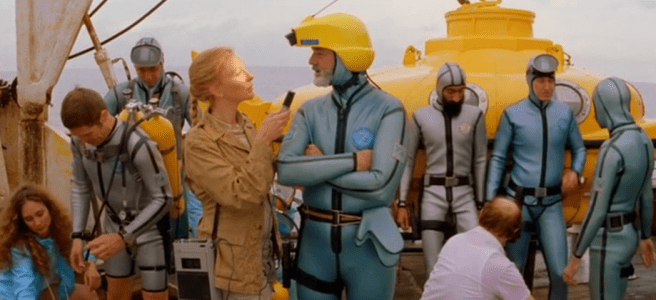
As Wes Anderson’s fourth film, The Life Aquatic with Steve Zissou has an interesting spot in Anderson’s career. Look backward and you can see within Life Aquatic many of the style choices that Anderson had used before. When looking forward, Life Aquatic is the beginning of Anderson’s interest of using miniatures and stop motion animation.
The Life Aquatic has Anderson’s characteristic mix of flat visuals and emotionless dialogue, just as it has what I believe are its intended effects: when a character tells the truth about their sadness or loneliness, the audience is pushed to an emotional depth unexpectedly — they had let their guard down in the atmosphere of witty writing, beautiful set design, and enviable needle drops.
But Life Aquatic is also one of Anderson’s more messy applications of his style. If we again think about the place of Life Aquatic in Anderson’s career, the budgets or the scopes of films that came after it do not weaken the precision of their emotional punches (e.g.,The Grand Budapest Hotel). Moments of The Life Aquatic of Steve Zissou can feel like Anderson was learning to use a power tool that has more torque than he expected.

 notes on cinema